I Thought I Had an ILJIN Supplier Problem. I Had a Paperwork Problem.
· Jane Smith
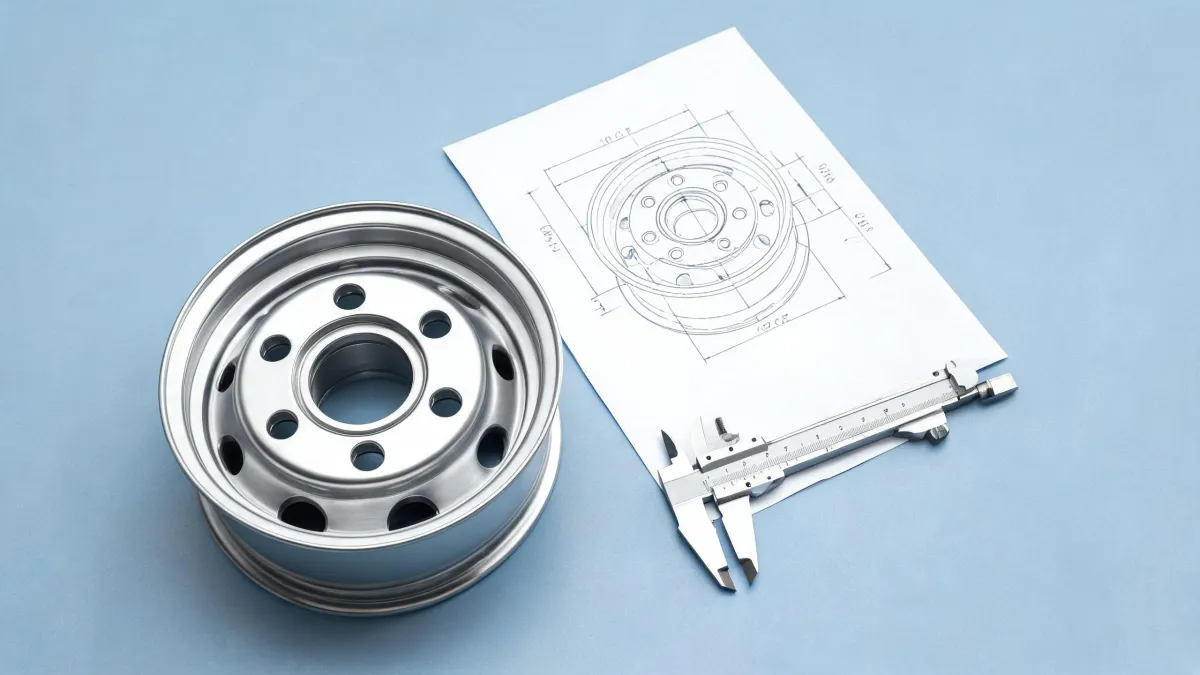
The Quote That Looked Like a Win
In November 2023, I lined up three quotes for a front wheel hub assembly run and put them side by side on a spreadsheet. Two came in between $41 and $44 per unit. The third was $36.80. That's roughly 15% lower, and across a 600-unit order it read like $1,900 of easy savings. I approved it.
Three weeks later our technical lead set one of the units on the bench, flipped it over, and pointed at the back of the flange. "This isn't what we ordered."
It was a front wheel hub assembly. It seated on the bore. It spun clean. It just didn't carry the ABS sensor ring our customer's vehicles needed, because the supplier had quoted the hub assembly and the wheel hub bearing assembly as two separate line items and I'd only read the top number. The pallet fee, the pre-shipment inspection, and the export crating weren't on the sheet at all. Landed cost worked out to $47.20 per unit.
We paid $3,100 to ship it back and rework the order. That's the short version. The longer version is what I actually learned, and it had almost nothing to do with finding another supplier.
"Where Do I Find a Reliable Supplier?" Is the Wrong Question
If you type where to find front wheel hub assembly suppliers in China into a search bar, you get a few hundred results in under a second. Alibaba pages, Made-in-China listings, trading companies posing as factories, factories posing as trading companies. If your problem were a volume problem, it would already be solved.
What I eventually understood—after ignoring it once and paying for it—is that the shortage isn't suppliers. It's verifiable information. And that shortage has three layers, only one of which is about the product.
1. You think you're comparing prices. You're comparing descriptions.
"Front wheel hub assembly" is not a specification. It's a product family. Two units can look identical in a product photo and differ on flange outside diameter, bolt hole count, PCD, bearing bore, caliper mounting boss height, and—the one that got me—whether the ABS encoder is a passive magnetic ring or an active sensor. The front passenger wheel hub assembly on one vehicle platform is not interchangeable with the front driver side on another.
Geometric tolerances matter too. ISO 492 sets the tolerance classes for radial bearings, and two hubs from two factories can both be "within tolerance" while sitting at opposite ends of the band. Put a tight-bore hub on a loose-shaft knuckle and you get a press-fit that fails at 40,000 km instead of 120,000. ISO 15243 catalogs bearing failure modes—fatigue, wear, corrosion, electrical erosion, plastic deformation, fracture—and almost none of them get diagnosed until the part is already back on your dock.
This is why front wheel hub assembly diagram sourcing is such a mess in practice. Half the drawings suppliers send you are scanned PDFs with revision letters nobody explains, dimensions that conflict with the part number in the header, and callouts in three different standards. I once received a drawing where the bolt circle was dimensioned in inches and the flange diameter in millimeters. Same document.
2. "We supply ILJIN" is a claim, not documentation.
Plenty of suppliers describe themselves as an ILJIN front wheel hub assembly supplier. Some genuinely are authorized channels. Others sell compatible units under the same OE referencing and let the buyer assume the rest. I'm not accusing anyone of fraud—most of the time it's just loose language that nobody corrects.
IATF 16949:2016 requires traceability through the production chain, and that requirement is real for certified facilities. What reaches your inbox, though, is usually a certificate scan and a promise. Three questions separate the two categories quickly:
- What's the production batch number on this shipment, and can you send the inspection report that matches it?
- Which drawing revision did you build to, and can you send that revision?
- If a unit fails incoming inspection, what's the return path and who pays freight?
Vendors who can answer all three in one email are worth talking to. Vendors who answer the first two and dodge the third are telling you something.
3. The number on the quote is not the number on the invoice.
This is the part I keep coming back to, because it's the cheapest problem to fix and the most expensive to ignore. A transparent quote is itemized: unit price, tooling or pattern amortization if any, pre-shipment inspection, packaging, palletizing, inland freight to port, FOB charges, and any MOQ surcharge above the base tier. None of that is exotic. It's just rarely written down.
I've learned to ask "what's not included" before I ask "what's the price." The vendor who lists everything upfront—even when the total looks higher—usually costs less by the time the container clears.
Why does this happen? Partly because unpriced variables are hard to quote: inspection intensity depends on your AQL, crating depends on mode of transport. Mostly, though, it happens because an incomplete quote competes better on a spreadsheet. That's not a supplier problem. That's a procurement process problem. Mine, specifically.
What It Actually Cost (The Part I Had to Explain to Finance)
Let me put the arithmetic down, because "we lost money on a cheap order" is too vague to change anyone's behavior.
- Nominal savings: $3.20/unit × 600 units = $1,920
- Return freight and rework: $3,100
- Expedited air freight to cover the gap: about $1,800 (I want to say $1,780, but don't quote me on the exact figure)
- Delay: 17 days, two of which hit a customer's line-side schedule
- My time: 11 hours of email over three weeks, which is roughly $480 at my loaded rate
Net position: about $3,460 worse than if I'd just paid the $44 quote from the start. That's the number finance cares about. But it's not the number that stung.
The number that stung was the technical lead scheduling a 10-minute review of every purchase order I touch for the next six months. That's what an unverified specification does to an office administrator's reputation—it converts you from "the person who runs procurement" into "the person who needs checking." I spent two years building the first thing and one purchase order losing it.
There's a compliance angle too. Finance now requires itemized landed cost on any PO above $5,000, which means every quote has to be broken out before it can be compared. Annoying at first. Genuinely useful by the third order.
What I Do Differently Now
Four changes. None of them clever.
Drawing first, price second. I don't accept a quote until I have the drawing revision that the quote is built against, in a readable format, with units stated. If the supplier can't produce it, I don't need to debate quality—there's nothing to compare.
Itemized quotes only. Every line, including the awkward ones. If a supplier pushes back, I explain that it's a finance requirement, which is true and also keeps me out of an argument I don't have standing to have.
Small trial order plus third-party inspection. One pallet, inspected against ISO 2859-1 general inspection level II, AQL agreed in advance. It costs a little and it catches the ABS problem before it becomes a $3,100 problem. Packaging should meet ISTA 3A for parcel or ISTA 2A for LTL if the shipment matters—I've had precisely one shipment arrive with a bent dust shield that "passed" inspection in origin photos.
Batch traceability in writing. Batch number on the packing list, inspection report matching the batch, drawing revision in the PO line. Three lines of text. Takes a supplier four minutes.
That's it. A lesson learned the hard way, which is the only way I seem to learn them.
Two Caveats, Because Context Matters
This worked for us, but we're a 180-person distributor with fairly predictable order patterns and a technical lead who'll actually check a part on a bench. If you're ordering one-off replacements for a fleet, or if nobody on your side can read a drawing, the calculus is different—you probably need an inspection agent more than you need a checklist.
I can only speak to what I've handled directly, which is front hub assemblies at moderate volume. If you're sourcing knuckle assemblies or steering components, the verification burden is higher than anything I've described here.
And one timing note: this was accurate as of January 2025. Chinese export pricing, freight rates, and certification requirements move quickly, so verify current terms before you budget. I learned the ABS lesson in late 2023, and I'd rather you didn't learn it in 2025 with a bigger order.

Jane Smith
I’m Jane Smith, a senior content writer with over 15 years of experience in the packaging and printing industry. I specialize in writing about the latest trends, technologies, and best practices in packaging design, sustainability, and printing techniques. My goal is to help businesses understand complex printing processes and design solutions that enhance both product packaging and brand visibility.